
Visitors:46 Publication time:2026-09-03
Recently, Horticultural Plant Journal published an online research paper from the team of Professor Li Jianming, Protected‑Agriculture Biology and Environment Group, College of Horticulture, Northwest A&F University. The paper is entitled Enhancing the coordination between transpiration and photosynthetic systems is key to improving water use efficiency and yield in tomato under different light conditions.
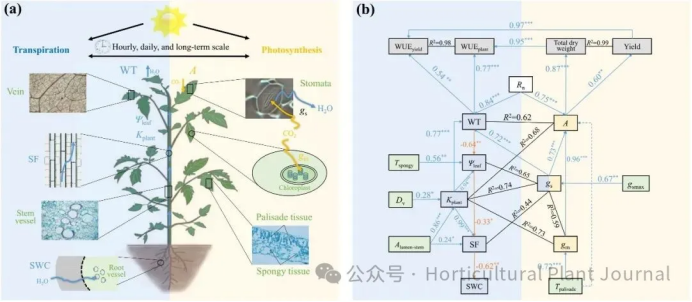
Plant transpiration and photosynthesis are primarily light‑driven. Improving crop water‑use efficiency (WUE) and yield via light‑environment regulation has become a critical research direction in protected horticulture. Nevertheless, systematic research remains scarce regarding how the coordinated relationship between transpiration and photosynthesis responds to light variations, especially its dynamic changes across multiple time scales (hourly, daily and full‑growth‑cycle scales).
To clarify the physiological mechanisms by which the coordination between transpiration and photosynthesis elevates WUE and yield, this study adopted tomato as the test material to investigate multi‑scale dynamic responses of transpiration and photosynthetic systems under different light intensities, light durations and supplementary‑lighting timings. The research aims to deliver theoretical references for optimizing greenhouse environmental‑regulation strategies and improve the productivity of protected‑horticulture crops in a more efficient and cost‑effective manner.
(1) Under experimental conditions, supplementary lighting at 200 W·m⁻² with a 16‑hour photoperiod applied around sunset enhanced water transport capacity and photosynthetic performance at hourly, daily and whole‑growth‑cycle scales, which significantly improved WUE and yield.
(2) Structural equation‑model analysis revealed that the coordination between water‑transport and photosynthetic systems was strengthened under the optimal light regime. This enabled plants to attain higher photosynthetic carbon‑assimilation efficiency per unit of water loss.
For greenhouse production, daily light‑environment management should be optimized from multi‑dimensional perspectives to strengthen coordination between transpiration and photosynthetic systems, so as to maximize resource‑use efficiency and crop productivity. This study supplies important theoretical evidence for improving resource‑use efficiency and crop productivity with higher efficiency and lower costs, and aligns with the high‑efficiency development trend of future protected agriculture and smart agriculture.
Paper Link: https://www.sciencedirect.com/science/article/pii/S2468014126002165
Backed by profound technical reserves and professional expertise, Jiayan (Beijing) Environmental Technology Co., Ltd. delivers one-stop technical services covering overall planning and design through system integration and construction. We customize tailored solutions to meet specific demands in key fields such as plant supplementary lighting, precise regulation of plant growth environments, industrialized plant cultivation, rapid tissue culture propagation, germination and seedling raising, germplasm resource preservation, breeding accelerators and other special artificial environments, injecting technological momentum into the full-chain development of digital and intelligent agriculture.
Contact Us
Company Name: Jiayan (Beijing) Environmental Technology Co., Ltd.
Hotline: +86 10-53328835
WeChat Official Account: Jiayan Environmental
Official Website: http://jiayanhuanjing.com/
Source: Horticultural Plant Journal WeChat Official Account