
Visitors:51 Publication time:2026-10-20
General Secretary Xi Jinping attaches great importance to the development of digital villages and smart agriculture. He has issued important instructions emphasizing that we should “target the main direction of agricultural modernization, raise the level of intelligent agricultural production and network-based operation, and help farmers increase their incomes”, and “make good use of modern information technologies to innovate rural governance models and elevate the level of sound rural governance”. In 2019, the General Office of the Communist Party of China Central Committee and the General Office of the State Council issued the Strategic Outline for the Development of Digital Villages. Since then, Central Government No.1 Documents have made important arrangements for advancing digital villages and smart agriculture for eight consecutive years. Various regions and relevant authorities have continuously promoted deeper integration of digital technologies with agricultural production and rural life, achieving important phased outcomes in building digital villages and developing smart agriculture.
Recently, the Cyberspace Administration of China and the Ministry of Agriculture and Rural Affairs jointly released the China Digital Rural Development Report (2019–2025) (hereinafter referred to as the Report), which systematically summarizes the achievements and experience of China’s digital rural development over the past seven years. Based on new circumstances and requirements, the Report presents a systematic development path underpinned by information infrastructure, centered on the data resource system, focused on smart agriculture and the rural digital economy, supported by digital culture and digital governance, expanded through information services and smart beautiful countryside initiatives, and guaranteed by policy mechanisms and talent teams. The Report serves as an important reference for comprehensively understanding development results and scientifically formulating the blueprint for digital rural development during the 15th Five-Year Plan period. It also responds to concerns from all sectors and shares with the international community China’s experience in leveraging digital technologies to drive the digital and intelligent transformation of agriculture and rural governance.
Looking back on the seven-year journey, as a core component of digital rural development, smart agriculture has transitioned from pilot exploration to rapid initiation and from localized breakthroughs to systematic advancement. Riding the wave of digitalization and marching toward intelligence, it provides robust support for agricultural and rural modernization.
Digital villages cover multiple dimensions including rural economy, governance, culture and services with rich connotations. The Report states that smart agriculture constitutes “an important component of new quality productive forces in agriculture and a key focus for the digitalization of rural industries”. Smart agriculture delivers solid industrial support for high-quality digital rural development and has become a critical driving force behind it.
According to the Report, seven years of exploration and rapid advancement have enabled smart agriculture to achieve “four major leaps”.
First, smart agriculture infrastructure has leaped from “basic coverage” to “in-depth empowerment”. Sound network infrastructure underpins the implementation of smart agriculture across farmlands, ponds and livestock barns. By the end of 2025, the internet penetration rate in rural areas reached 69.5%, an increase of 31.1 percentage points compared with the end of 2018. The digital transformation of traditional infrastructure has built a more solid hardware foundation and scenario support for smart agriculture, with continuous upgrading of rural water conservancy, farmland, power grids, rural highways and delivery & logistics systems. Agricultural data resources have grown increasingly abundant, providing foundational resources and innovation engines for the application of smart agriculture. New infrastructure such as the space-air-ground integrated monitoring network is being accelerated, while the development and utilization of agriculture-related data including price information from national agricultural product wholesale markets continue to deepen.
Second, key technologies and equipment have leaped from “fundamental capacity” to “core capability”. Significant progress has been made in the R&D and application of intelligent agricultural machinery and equipment. Deep integration of new-generation information technologies with agricultural equipment is accelerating the shift of agricultural production from “farming at the mercy of weather” to “farming with weather awareness”. An innovation system for smart agriculture linking industry, academia, research and application is taking shape rapidly, supporting a batch of breakthrough innovations in key smart agricultural technologies and equipment.
The Report shows that by the end of 2025, a total of 34 smart agriculture innovation centers and sub-centers and 116 smart agriculture innovation application projects had been built. Breakthroughs were achieved in the R&D of 104 key smart agricultural technologies and 62 complete sets of intelligent equipment. Quality control over smart agricultural technologies and equipment has become stricter, and their application and promotion keep expanding. A national metrology and testing center for agricultural machinery industry has been deployed to strengthen research and application of computational testing technologies for the agricultural machinery sector.
Third, digitalization of major industries has leaped from “isolated trials” to “large-scale popularization”. In field crop cultivation, a space-air-ground integrated agro-meteorological perception and data-driven model has taken initial shape, enabling dynamic monitoring of growth conditions for rice, wheat and corn. By the end of 2025, more than 3.5 million sets of Beidou terminals for agricultural machinery had been rolled out, the inventory of agricultural drones exceeded 300,000 units, and annual operation coverage surpassed 460 million mu. Shared leasing of intelligent farm machinery is gaining rapid popularity.
In livestock breeding, intelligent technologies such as precision feeding, environmental control and behavior analysis are widely adopted in hog farming and high-rise efficient poultry production. A total of 659 animal epidemic prevention channels nationwide have been brought under information-based management, making animal quarantine supervision smarter, more convenient and more efficient. In fisheries, digital technologies continuously empower diversified aquaculture models. Intelligent cage equipment, feeding robots and other smart devices are undergoing rapid iteration, lifting the intelligence level of mariculture.
Fourth, food security assurance has leaped from “manual management and control” to “digital and intelligent empowerment”. Food security is a matter of national strategic importance, and digital-intelligent technologies are building a solid safeguard for it. In terms of farmland protection, the basic database for the “one-map” system including the “three zones and three lines” has been further improved, laying a stronger data foundation for “storing grain in land” and helping safeguard the redline of 180 million mu of arable land.
For seed industry revitalization, the China Seed Industry Big Data Platform has been put into operation. The national crop germplasm resource information platform has released information on 588,000 national germplasm resources in repositories and nurseries, providing a solid resource base for breeding innovation. In disaster prevention and loss reduction, meteorological early warning information has been fully connected to 1.23 million national emergency broadcasting terminals, and “flash message” technology has been piloted in 386 cities and counties across 16 provinces, refining the emergency response linkage mechanism led by meteorological alerts. In grain storage, digital warehousing technologies have kept the comprehensive grain loss rate within 1% during storage cycles, delivering notable results in grain conservation and loss reduction. From sowing to harvest and from farmland to granaries, digital-intelligent technologies are empowering the national food security guarantee system across the whole industrial chain.
Over the past seven years, amid the profound transformation of agriculture accelerated by the information revolution, smart agriculture has enjoyed faster development and digital village construction has moved forward in depth. This has made agriculture a more promising industry and rural areas more livable and desirable places to work, contributing significantly to building a cyberpower and an agricultural powerhouse. Seven years of practice has deepened our understanding of the laws governing smart agriculture development.
First, coordinated efforts between government guidance and market mechanisms. Documents issued by the CPC Central Committee and the State Council including the Plan for Accelerating the Building of an Agricultural Powerhouse (2024–2035), as well as documents released by the Ministry of Agriculture and Rural Affairs such as the Guiding Opinions on Vigorously Developing Smart Agriculture and the National Smart Agriculture Action Plan (2024–2028), form the fundamental framework for smart agriculture. Over the seven years, from the layout of smart agriculture innovation centers and the implementation of innovative application projects, to the selection of promoted technologies, recommendation of typical cases and smart agriculture innovation competitions, the “visible hand” of the government has played a vital role in building platforms, lowering entry barriers and advancing industrialization.
Meanwhile, platform economy has helped expand entrepreneurial space. Returning youth, family farms, farmers’ cooperatives and individual rural merchants access markets, connect with consumers and reshape business models via platforms. New business forms such as rural e-commerce and digital services have flourished, and the “invisible hand” of the market has further boosted the momentum and vitality of smart agriculture development.
Second, deep integration of technological innovation with local agricultural realities and agronomy. Agriculture differs from industry and rural areas from cities. Developing smart agriculture and building digital villages must adhere to problem-oriented and application-oriented approaches, adopting technical routes that are appropriate, low-cost and easy to operate. The rapid large-scale rollout of Beidou terminals for farm machinery in recent years stems from their effective alignment with actual production demands in key links such as sowing and harvesting, making technologies accessible, affordable and usable for farmers.
Third, organic linkage between smart agriculture and smallholder farmers. China’s basic national and agricultural condition of “a large country with numerous smallholder farmers” dictates that the large-scale application of smart agriculture must follow a realistic path enabling smallholders to share digital dividends. Various agricultural socialized service organizations are expanding rapidly. By centrally purchasing smart equipment, scheduling operations in a unified manner and offering “menu-style” services, they convert advanced technologies and equipment including intelligent farm machinery, drone plant protection and precision fertilization into standardized on-demand services for smallholders, effectively solving the challenge that smallholders “cannot afford or properly operate such technologies”. Acting as a bridge through socialized services, smart agriculture has become an important channel linking smallholder farmers with the development of modern agriculture.
The 15th Five-Year Plan period marks a critical phase for basically realizing agricultural and rural modernization. Looking ahead to the next five years, digital villages will accelerate their transition toward digital-intelligent villages, and smart agriculture construction will enter a pivotal stage of innovative development and practical delivery. The 15th Five-Year Plan for Accelerating Agricultural and Rural Modernization clearly stipulates that we shall “promote the application of artificial intelligence and the development of smart agriculture”. This requires us to both summarize and leverage valuable experience accumulated in practice, and accurately grasp new trends in digital-intelligent technologies and agricultural development.
Currently, the rapid evolution of digital-intelligent technologies such as artificial intelligence is profoundly reshaping the underlying logic of agricultural development and bringing unprecedented opportunities for smart agriculture.
First, the data industry is being fostered faster to unlock the value potential of production factors. Data has gradually evolved from an auxiliary tool supporting agricultural and rural development into a new type of production factor with independent value and market operational potential. Its role as a foundational resource and innovation engine is increasingly prominent. Digital-intelligent technologies are being internalized as driving forces in agriculture and rural areas. We must prioritize data, further accelerate “the coordinated deployment of agricultural and rural data infrastructure” and “develop the data industry in agriculture and rural sectors”.
Second, application scenarios are expanding across the whole industrial chain, with scenario-driven development becoming a key engine. Large agricultural models and intelligent equipment are rapidly deployed in scenarios including biological breeding, agro-condition monitoring, production management, identification and prevention of animal and plant diseases, and yield forecasting. The efficiency of scenario-driven technology iteration is increasingly evident. We need to build diverse application scenarios and “accelerate the expansion of AI application scenarios in agriculture”.
Third, emerging industries are nurtured to open new frontiers for agricultural development. Pioneering industries including intelligent design breeding, new-energy farm machinery and the agricultural low-altitude economy are developing at scale, opening brand-new tracks for high-quality smart agriculture development. Starting from priority areas in urgent industrial demand such as intelligent breeding, we shall accelerate the “cultivation of new rural industries and business forms”.
The release of the Report is not only a phased summary but also a call to action for a new journey. Facing the 15th Five-Year Plan, we must resolutely implement the deployment requirements of the CPC Central Committee and the State Council to vigorously advance “AI + agriculture”. We will consolidate foundations in infrastructure, concentrate efforts to achieve breakthroughs in key technologies and equipment, expand coverage and improve efficiency in industrial digitalization, and build a solid digital line of defense for food security. We will accelerate smart agriculture’s transition from “local breakthroughs” to “widespread momentum” and from “quantitative accumulation” to “qualitative leap”. Through innovative development of smart agriculture, we will promote high-quality development of digital villages and inject stronger digital and intelligent momentum into accelerating agricultural and rural modernization and solidly advancing comprehensive rural revitalization.
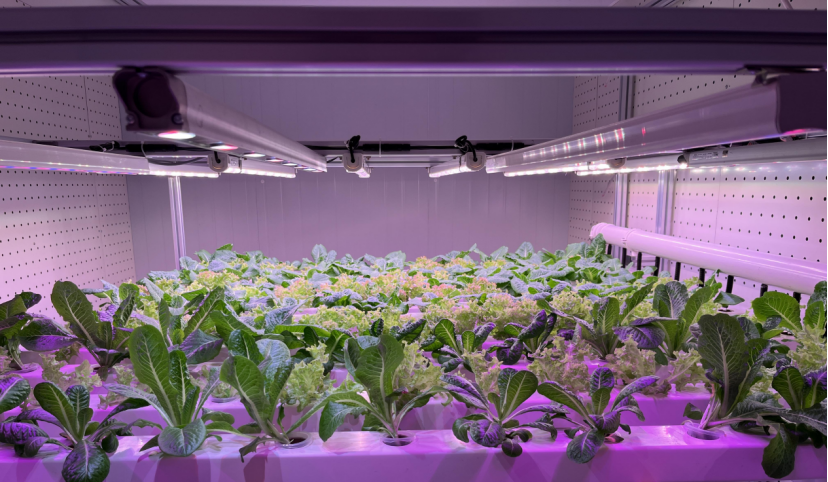
Backed by profound technical reserves and professional expertise, Jiayan (Beijing) Environmental Technology Co., Ltd. delivers one-stop technical services covering overall planning and design through system integration and construction. We customize tailored solutions to meet specific demands in key fields such as plant supplementary lighting, precise regulation of plant growth environments, industrialized plant cultivation, rapid tissue culture propagation, germination and seedling raising, germplasm resource preservation, breeding accelerators and other special artificial environments, injecting technological momentum into the full-chain development of digital and intelligent agriculture.
Contact Us
Company Name: Jiayan (Beijing) Environmental Technology Co., Ltd.
Hotline: +86 10-53328835
WeChat Official Account: Jiayan Environmental
Official Website: http://jiayanhuanjing.com/
Source: “Cyberspace China” WeChat Official Account